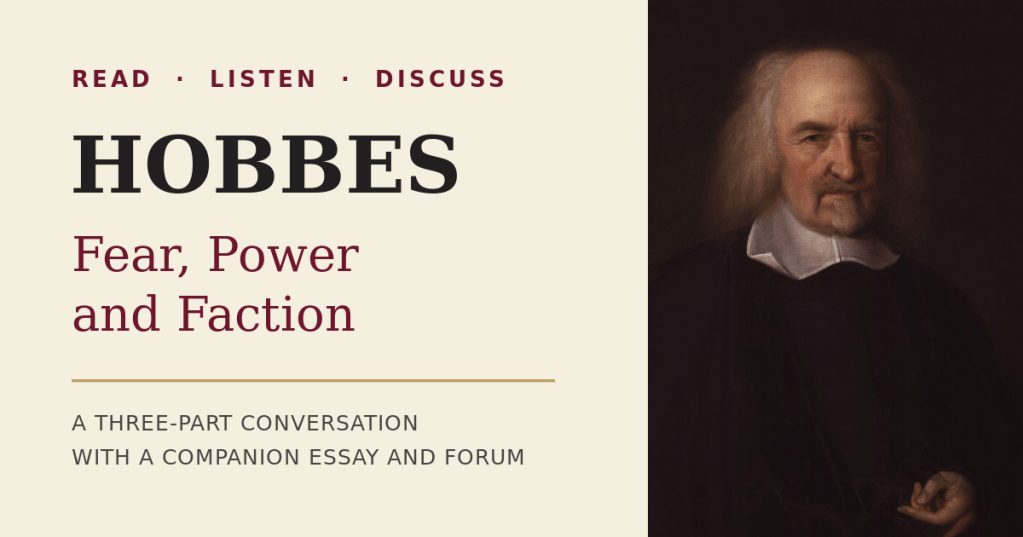
How did Hobbes’s experience of political and religious turmoil shape his philosophy?
The opening episode of Hobbes: Fear, Power and Faction follows Thomas Hobbes from his birth in 1588 through the political and religious crises that shaped his mature thought. Samuel Woodall and Jack Thomson ask why fear became so central to Hobbes’s account of human life, and why the search for security led him towards such an uncompromising theory of political authority.
Watch the episode
In this discussion
- Hobbes’s life and the political crises through which he lived
- The state of nature and the fear of violent death
- Why insecurity is social and political, not simply psychological
- How fear can make cooperation and political authority possible
Audio chapters
Times refer to the Buzzsprout audio recording. Open the audio chapter navigation.
- 0:00 Welcome Back And New Format
- 1:13 Who Was Hobbes And Why Fear
- 4:12 Oxford, Languages, And Patronage
- 8:09 Travel, Geometry, And Thucydides
- 10:54 1640 Crisis And Exile To Paris
- 12:58 Sovereignty And Political Backlash
- 15:12 Civil War Catastrophe And Authority
- 17:28 Realism, Covenants, And Peace
- 19:03 Fear, Liberty, And The Commonwealth
- 22:10 What We Read Next
Read and discuss
Read the companion article at The Intellectual Historian, explore the full series introduction, and join the Reading Club discussion, What Do We Owe the State?
Continue: Episode 2 – Why Should We Obey the State?
Read alongside the conversation
John Aubrey, “Thomas Hobbes of Malmesbury,” Brief Lives, alongside Hobbes’s preface to De Cive.


2 responses
[…] Episode 1 – Who Was Thomas Hobbes, and What Was He Afraid Of?Next: Episode 3 – When Does Disagreement Become […]
LikeLike
[…] Return to: Episode 1 – Who Was Thomas Hobbes, and What Was He Afraid Of? […]
LikeLike