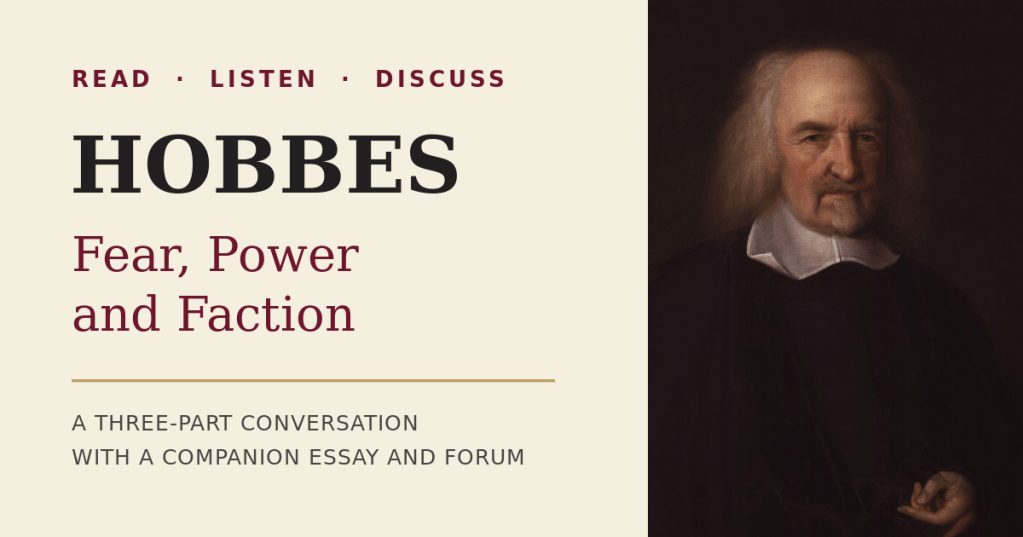
Is faction simply organised disagreement, or does it threaten the existence of the political community?
The final episode of Hobbes: Fear, Power and Faction asks when disagreement becomes politically dangerous. Samuel Woodall and Jack Thomson turn to De Cive, chapter 12, to explore Hobbes’s fear of competing authorities, the relationship between religious conflict and sedition, and what his argument contributes to the longer history of faction, party and loyal opposition.
Watch the episode
In this discussion
- The difference between private disagreement and organised faction
- Hobbes’s fear of divided sovereignty and competing authorities
- Religion, political language and the causes of civil conflict
- What Hobbes can contribute to the history of party and loyal opposition
Audio chapters
Times refer to the Buzzsprout audio recording. Open the audio chapter navigation.
- 0:00 Welcome And The Faction Question
- 1:20 Disagreement Versus Rival Authority
- 3:50 De Cive And Narrative Control
- 6:50 The Anatomy Of Sedition
- 10:30 The People The Multitude The King
- 13:00 Sovereign Responses And Civil War Risks
- 15:30 Rhetoric Inner Circles And Mobilisation
- 18:10 Liberty Fear And The Water Channel
- 20:00 Glorious Revolution And Your Reply
Read and discuss
Read the companion article at The Intellectual Historian and join the Reading Club discussion, What Do We Owe the State?
Return to: Episode 1 – Who Was Thomas Hobbes, and What Was He Afraid Of?
Read alongside the conversation
Hobbes, De Cive, chapter 12, especially sections 1, 8 and 11–13.


One response
[…] Previous: Episode 1 – Who Was Thomas Hobbes, and What Was He Afraid Of?Next: Episode 3 – When Does Disagreement Become Faction? […]
LikeLike