Rousseau: Self, Freedom and Education · Episode 3 of 3
Samuel Woodall and Jack Thomson explore education, independence and the tutor’s power in Rousseau’s Emile. This episode page provides the scheduled recording links, episode context and reading references; follow the companion link for the scholarly argument and the Club link to discuss the questions it raises.
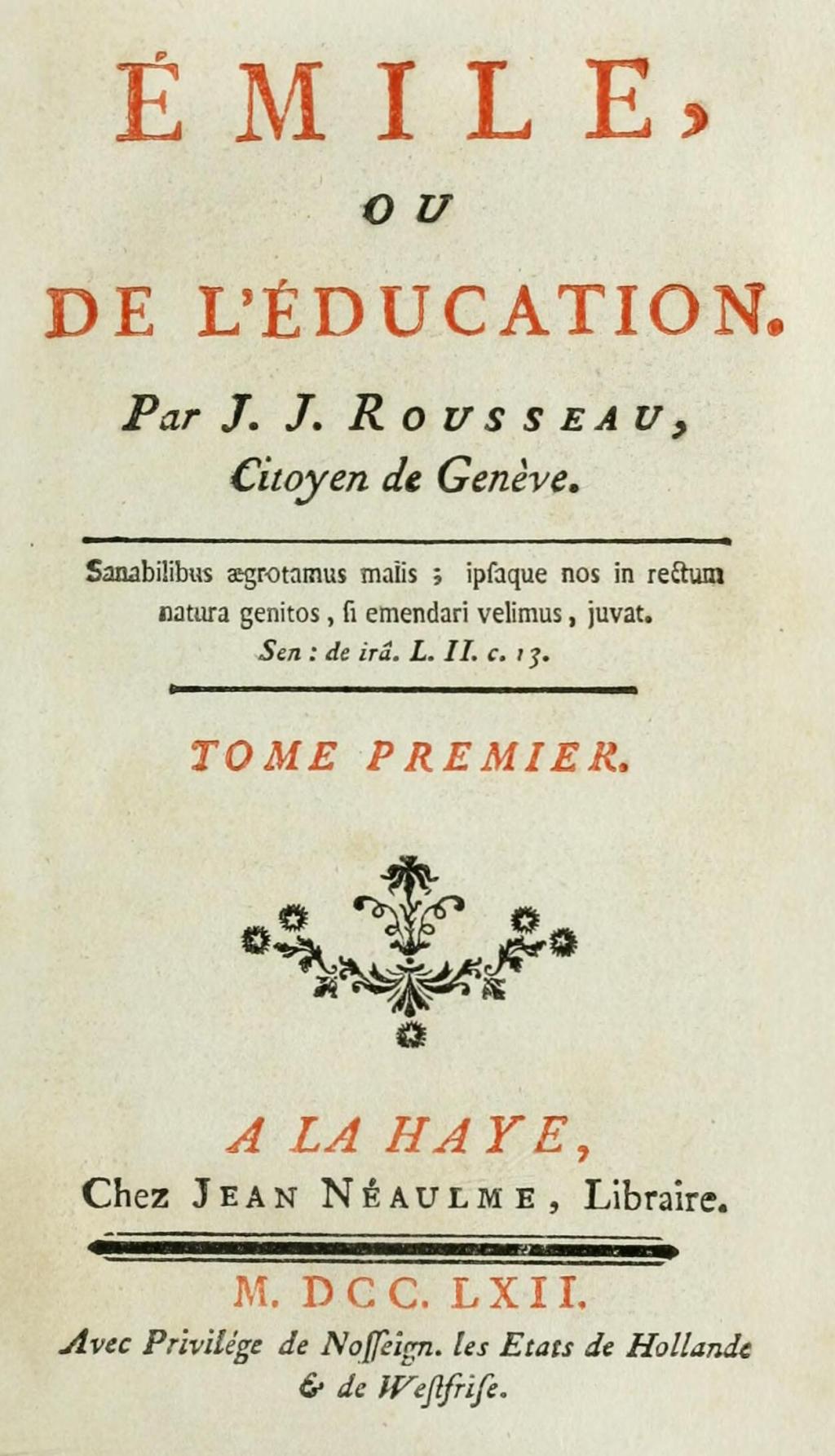
Follow the pupil and the tutor as separate perspectives. Émile’s freedom to learn exists inside an environment managed by an adult. Read that arrangement alongside Sophie’s education to ask how far the promise of independence extends, and whether guidance can prepare a learner to question the guide.
Read alongside us
Émile, Book II, learning through experience; Book V, Sophie’s education. Read short passages from each rather than the whole book.
The Rousseau series follows a Monday, Wednesday and Friday release pattern: 12, 14 and 16 October 2026 at 10pm UK time. Use the Listen and Watch buttons above for episode three, “Can Education Save Us from Society?”, with Samuel Woodall and Jack Thomson.
Rousseau: Self, Freedom and Education · Episode 2 of 3
Listen or watch Samuel Woodall and Jack Thomson discuss inequality, dependence and freedom under law. This episode page brings together the recording, its central questions and reading references; follow the companion link for the scholarly argument and the Club link to join the discussion.
Bring the origins of unequal dependence into conversation with the demand for legitimate government. Our reading route moves from property in the Discourse on Inequality to association, civic freedom and the general will in The Social Contract. Distinguish a common interest from the wishes of a ruler or a collection of private advantages.
Read alongside us
Discourse on Inequality, Part II, opening account of property; The Social Contract, I.6-8 and II.1-3.
Episode two, Can Society Make Us Free Again?, is available now through the audio and video links above. Read the companion article and join the shared Rousseau discussion below. Episode three is planned for Friday 16 October 2026 at 10pm UK time.
What would distinguish a law serving a common interest from a majority imposing its preferences?
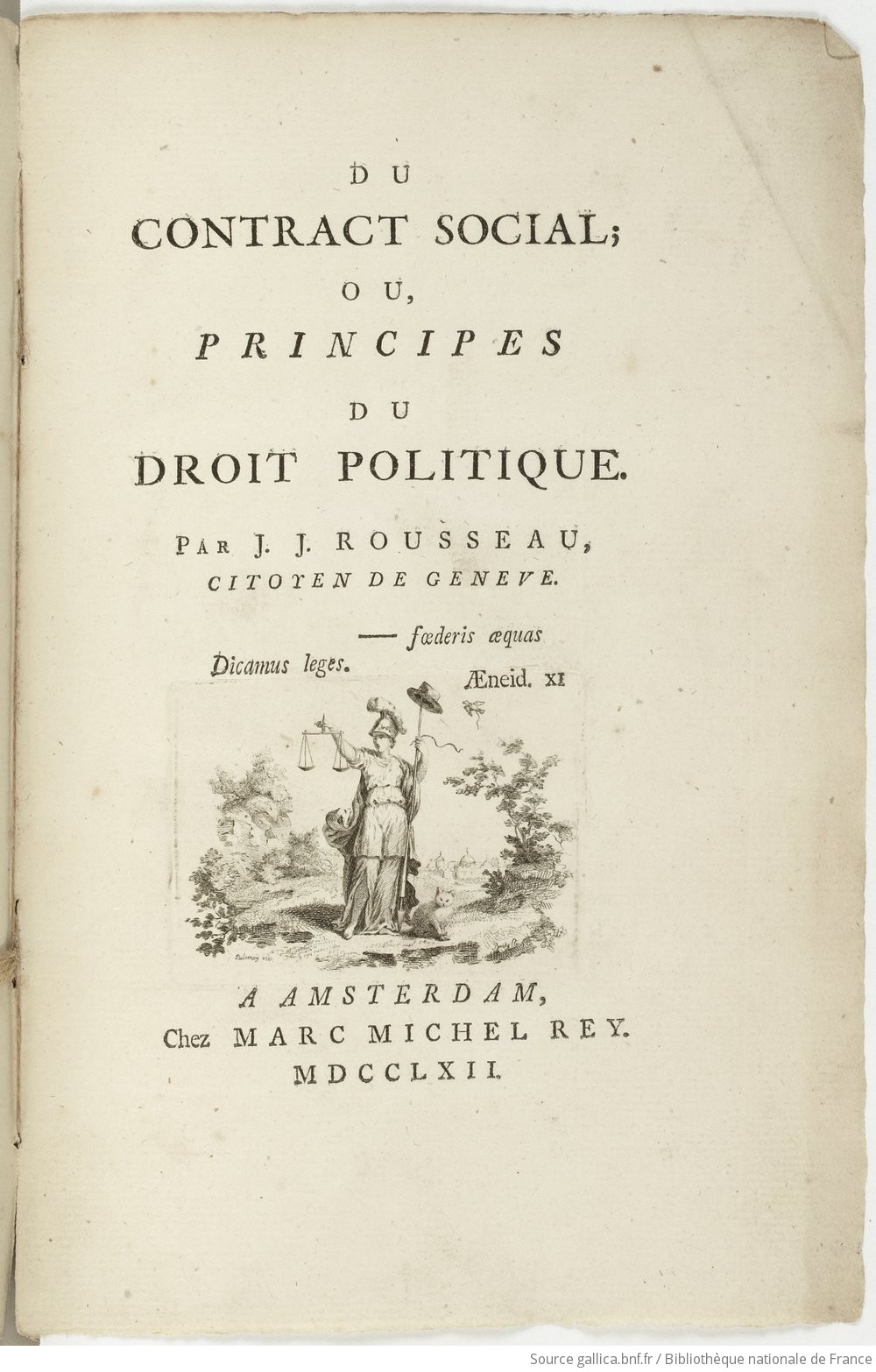
Image: Jean-Jacques Rousseau, Du contrat social, title page, 1762. Bibliothèque nationale de France. Public domain, via Wikimedia Commons. Source and image details.
Rousseau: Self, Freedom and Education · Episode 1 of 3
Listen or watch Samuel Woodall’s solo introduction to Rousseau’s life and Confessions. This episode page brings together the recording, its central questions and reading references; follow the companion link for the scholarly argument and the Club link to discuss a passage.
Begin with the opening of Rousseau’s Confessions, then the stolen ribbon episode in Book II. Notice how recollection, motive and an appeal for understanding can pull in different directions. The central question is how we judge a story told by the person whose conduct is at issue.
Read alongside us
Confessions, Book I, opening pages; Book II, the stolen ribbon and Marion.
Montaigne: Self, Doubt and Difference · Episode 3 of 3
The final part of our Montaigne reading series asks how we judge unfamiliar societies. Read Of Cannibals, Of Cruelty and Of Coaches alongside one another to examine custom, European violence, conquest and the limits of cultural comparison.
Listen or watch the conversation
Choose the audio episode or the video conversation. Both open directly in their player.
Montaigne: Self, Doubt and Difference · Episode 2 of 3
Does thinking about death set us free, or keep us trapped by fear? Samuel Woodall and Jack Thomson explore preparation for death, virtue and pleasure, education through judgement, and the attention to ordinary life and bodily limits that complicates Montaigne’s account of mortality.
Montaigne: Self, Doubt and Difference · Episode 1 of 3
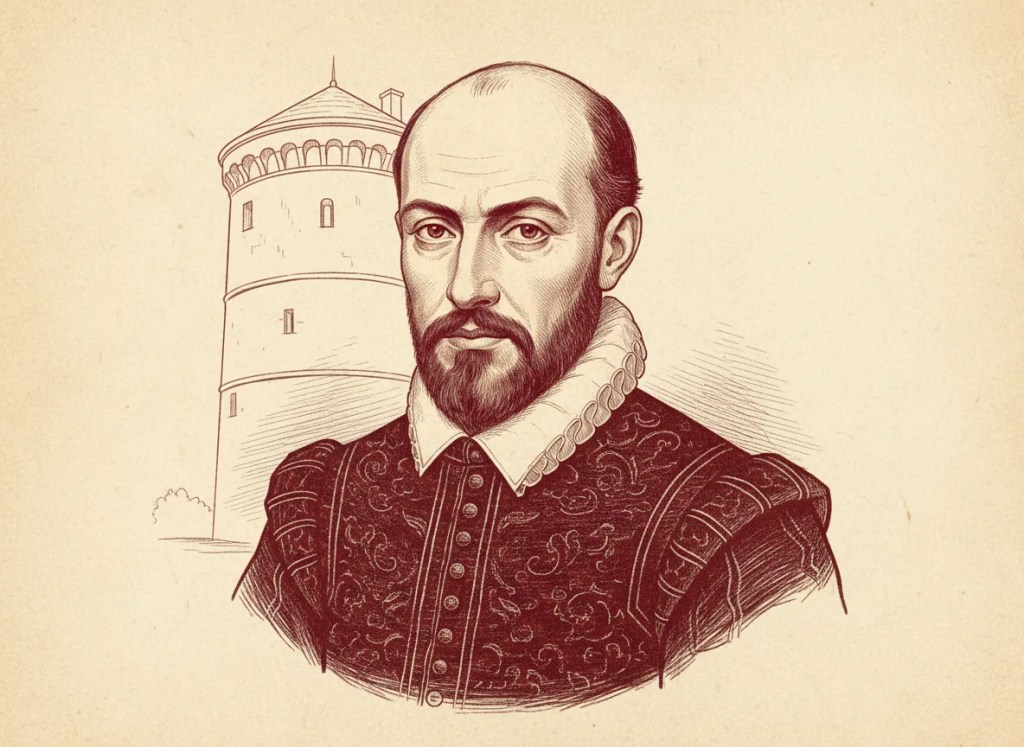
Samuel Woodall and Jack Thomson begin their three-part Montaigne series with his classical education, friendship and public life, his retreat to the tower library, and the changing self at the centre of the Essays. Is his candour straightforward honesty, literary performance, or an invitation to exercise our own judgement?
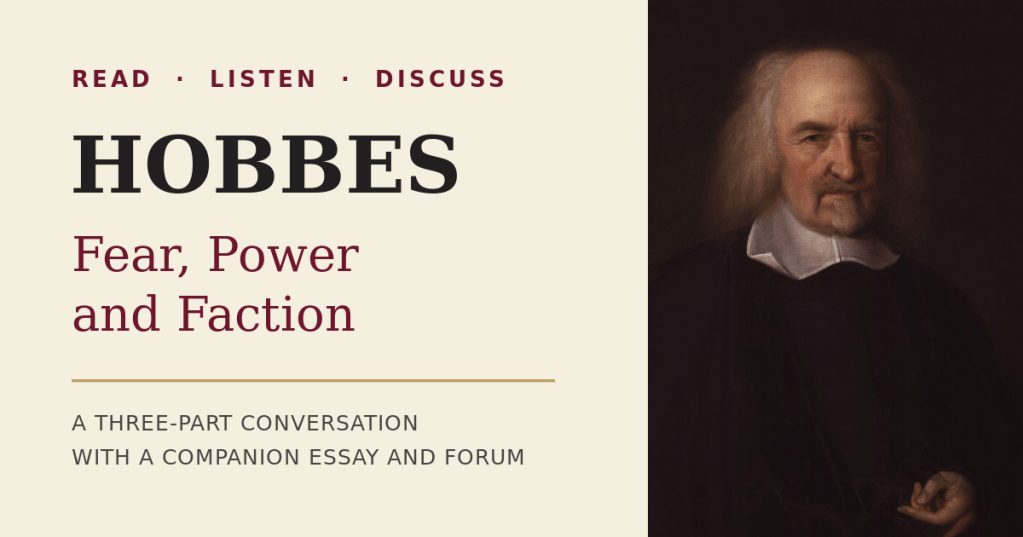
Is faction simply organised disagreement, or does it threaten the existence of the political community?
The final episode of Hobbes: Fear, Power and Faction asks when disagreement becomes politically dangerous. Samuel Woodall and Jack Thomson turn to De Cive, chapter 12, to explore Hobbes’s fear of competing authorities, the relationship between religious conflict and sedition, and what his argument contributes to the longer history of faction, party and loyal opposition.
If political authority is created by human beings, why does it acquire the right to command them?
The second episode of Hobbes: Fear, Power and Faction turns from fear to political obligation. Samuel Woodall and Jack Thomson examine why Hobbes believed that agreement alone could not preserve peace, why covenants require enforcement, and how individuals come to authorise a sovereign with the power to decide disputes.
How did Hobbes’s experience of political and religious turmoil shape his philosophy?
The opening episode of Hobbes: Fear, Power and Faction follows Thomas Hobbes from his birth in 1588 through the political and religious crises that shaped his mature thought. Samuel Woodall and Jack Thomson ask why fear became so central to Hobbes’s account of human life, and why the search for security led him towards such an uncompromising theory of political authority.
Thomas Paine emerged from a background marked by relative lack of success, having encountered failure in numerous pursuits during his early life. He exhibited strong support for the American Revolution, notably more so than Edmund Burke, as demonstrated by his seminal work Common Sense (published in 1776), which was disseminated among American troops engaged in combat against the British. His Rights of Man (published in two parts in 1791 and 1792) galvanized a generation of liberals; in his 1792 Letter Addressed to the Addressers on the Late Proclamation, he described his project as an effort to “expose the fraud and imposition of monarchy.” Paine was resolutely opposed to ritual and tradition for their own sake, perceiving monarchy as a parasitic entity that drains resources from the general populace.1
The Common Sense:
Thomas Paine’s Common Sense, published in January 1776, was a groundbreaking pamphlet that played a pivotal role in galvanizing public support for American independence. By its publication, tensions between the American colonies and Britain had escalated, particularly following events like the Boston Massacre in 1770 and the Boston Tea Party in 1773. In clear and articulate prose, Paine argued against monarchy and hereditary succession, advocating instead for a democratic republic. He emphasized the natural rights of individuals, the importance of self-governance, and the detrimental effects of British rule on the American colonies, as Britain committed a large military force to suppress the rebellion. Paine’s work combined Enlightenment ideals with practical political theory, effectively appealing to the colonists’ sense of justice and reason, and selling an estimated 120,000–150,000 copies in its first year. By addressing both the emotional and rational aspects of political discourse, Common Sense inspired widespread revolutionary sentiment, culminating in the Declaration of Independence on July 4, 1776, and ultimately influencing the course of American history while challenging the established order of governance.2
The Rights of Man:
Thomas Paine’s Rights of Man, published in two parts in 1791 and 1792, emerged as a seminal text in the discourse of intellectual history, advocating for the principles of democracy and individual rights during a period of revolutionary fervor in Europe and America. This work was a direct response to Edmund Burke’s conservative critique in Reflections on the Revolution in France (1790), and it championed the notion that government should be a product of the people’s will rather than a divine or hereditary imposition. Paine argued for universal suffrage and the inherent rights of individuals, positing that all men are born equal, a radical assertion for its time, echoing the sentiments of the Enlightenment. His ideas contributed to the political landscape that would inform the creation of democratic governments, influencing revolutions such as the French Revolution in 1789 and the broader struggle for human rights that gained momentum in the 18th and 19th centuries, marking a significant evolution in the concept of citizenship and governance.3
Of those who argued for gradual reform, Paine saw them as a condescending elite who “pities the plumage, but forgets the dying bird.” That is to say, they wished to improve the lives of the worst somewhat, whilst fundamentally leaving them in the same position as they were before. The way he wrote chimed with working people who could look up and see the ‘bird’ flying free above them, whilst they remained subject to the cruel realities of working life in London.4
Therefore, the people should be judged by what they achieve in their rebellious politics, and radicals should not accept the maintenance of the status quo. Tradition for Paine is nonsense, and it should not be blindly accepted, as he pens, “Reason obeys itself; ignorance submits to whatever is dictated to it.” From this standpoint, Paine believed that society needed to be based and built around the core Enlightenment notion of reason, and that one should only obey a social contract when one sees a reason why one should do so.5
The Age of Reason:
Now the ‘Age of Reason’ had arrived, and so too had the Age of Reason by Thomas Paine in 1794. Paine (1736-1809) had been an interesting Enlightenment thinker from elsewhere in Enlightenment Britain to Edinburgh. He had been born into a Quaker family, which shaped his liberal attitudes towards the age’s new shifts in thought. Paine left England in 1792 after being warned by his friend William Blake that arrest was imminent. He was later imprisoned in Paris during the Terror; the second part of The Age of Reason was composed during and after that imprisonment. But what is so interesting about this text is that it encapsulates the complexities of the era; it argues in support of Enlightenment tropes such as reason over the irrational, but also reinforces a belief in the divine against the established church.6
Just like other scholars such as Voltaire, Paine saw established religion as corrupt but certainly didn’t reject religion per se. Reason, for him, brought humans to the conclusion that there is a deity and rejected the miracles and mysticism of religious teachings of the past. Therefore, we can see the non-secular elements of this transformative age revealing themselves. Moreover, Paine had been in dialogue earlier with Jefferson about his drafting of the Declaration of Independence (1776), and this reveals where the American thinkers would pick up certain Enlightenment themes of liberty, religious toleration, and the use of reason.7
A young William Blake urges Thomas Paine to flee. Bronzes made by James Butler.
By way of conclusion:
The parliamentary franchise expanded unevenly after Paine’s time through the Reform Acts of 1832, 1867, and 1884, and the Representation of the People Act 1918, which enfranchised most adult men and many women over thirty. This was realistically very slow reform, but the life and thought of Paine set in motion a turn toward reason over ritual, and ideals over ignorance.8
About the author
Samuel Woodall is an intellectual historian and university teacher whose doctoral research examines political and religious faction in eighteenth-century Britain.
Thomas Paine, Rights of Man, parts 1–2 (1791–92); Thomas Paine, Letter Addressed to the Addressers on the Late Proclamation (1792), opening paragraph. ↩
Eric Foner, Tom Paine and Revolutionary America (New York: Oxford University Press, 1976), 75–107. ↩
Thomas Paine, Rights of Man, parts 1–2; Edmund Burke, Reflections on the Revolution in France (London: J. Dodsley, 1790). ↩