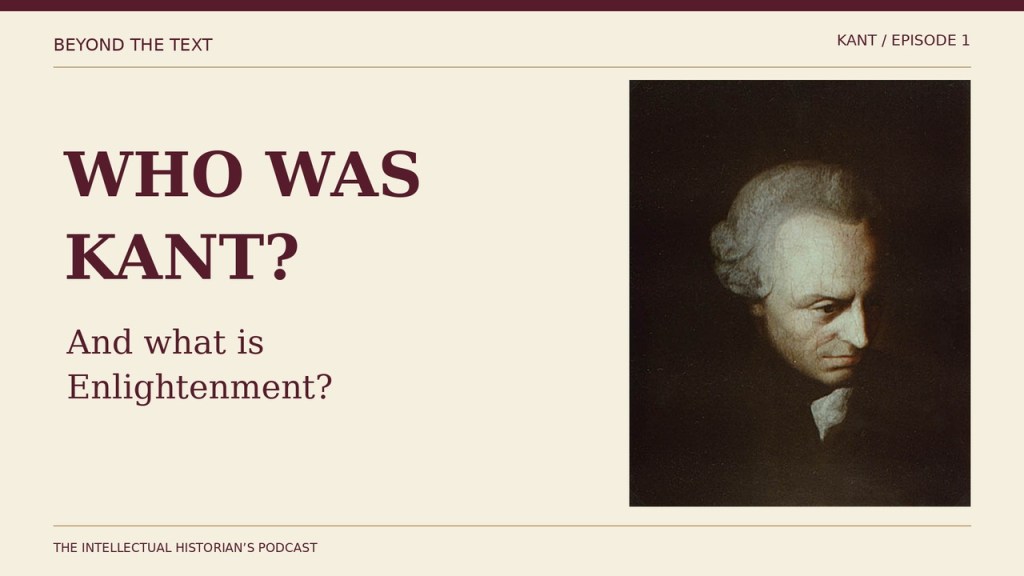
Kant · Episode 1 of 3 · Samuel Woodall and Jack Thomson
What does it mean to think for yourself? Our Kant series begins with the life behind the philosophy and a question that reaches beyond eighteenth-century Prussia: when does guidance help us to judge, and when does it become a substitute for judgement?
Listen to the episode · Watch on YouTube
A life in Königsberg
Immanuel Kant (1724–1804) is often introduced through his famously regular habits. In this opening conversation, we put the timetable back into a fuller life: his upbringing, his interest in the sciences, his academic career and the sociable world of conversation and shared meals. The philosopher of reason was also a person formed by a particular city, education and set of intellectual disputes.
Kant became professor of logic and metaphysics at Königsberg in 1770. His Critique of Pure Reason appeared in 1781; the short essay “What Is Enlightenment?” followed in 1784. These dates help orient the series, but the episode’s larger question is how intellectual independence can coexist with an acknowledgement of human limits.
Courage and limits
The call to dare to know sounds expansive. Yet Kant’s critical project also asks what reason is entitled to claim. These concerns belong together: thinking independently requires us to examine the grounds of an assertion, including our own. Confidence alone cannot do that work.
Listen for the movement between biography, science and metaphysics. We discuss Descartes and Leibniz, introduce the ambition of the first Critique, and turn to enlightenment, freedom and dignity. The episode opens the questions that the next two conversations will develop; it is an invitation into Kant rather than a complete account of his system.
A distinction to keep in view
In the 1784 essay, Kant’s distinction between public and private reason has an unfamiliar meaning. Public reasoning addresses the wider reading public; private reasoning concerns the duties of a particular office. Keeping those definitions in view makes the essay more challenging than a simple endorsement of saying whatever one thinks.
A reading clarification: Christian Wolff belongs to the rationalist tradition associated with Leibniz, rather than the empiricist tradition. This is a useful distinction to keep clear when following the episode’s discussion of Kant’s intellectual background.
Episode chapters
00:00 — Welcome to Beyond the Text
02:11 — Enlightenment and thinking for yourself
04:51 — Kant’s life and Königsberg
06:04 — The young Kant and the sciences
08:51 — Descartes, method and metaphysics
11:08 — Professor Kant and everyday life
12:50 — The Critique of Pure Reason
16:26 — What is Enlightenment?
18:31 — Freedom, knowledge and human dignity
20:47 — Perpetual Peace and what comes next
Read and discuss
Read Kant’s “What Is Enlightenment?” (1784), translated by Mary C. Smith. For background, see the Stanford Encyclopedia of Philosophy entry on Kant.
Before listening again, try this question: what would count as evidence that you had examined a belief for yourself? Could you explain its reasons, recognise a serious objection and say what might change your mind?
Next in the series, we turn more closely to the Critique of Pure Reason.
Explore the Kant conversation
Episode guide and chapter links · Thinking for Yourself: companion essay · Reading-club questions


Leave a Reply