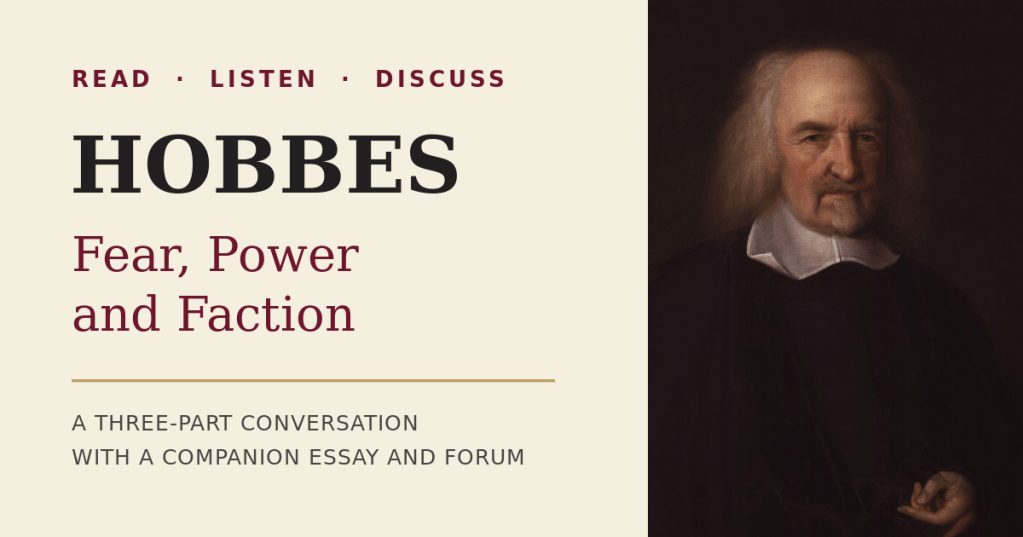
If political authority is created by human beings, why does it acquire the right to command them?
The second episode of Hobbes: Fear, Power and Faction turns from fear to political obligation. Samuel Woodall and Jack Thomson examine why Hobbes believed that agreement alone could not preserve peace, why covenants require enforcement, and how individuals come to authorise a sovereign with the power to decide disputes.
Watch the episode
In this discussion
- Why agreements cannot secure peace without enforcement
- The difference between covenant, consent and authorisation
- Why Hobbes assigns the sovereign such extensive powers
- Whether obligation survives when protection fails
Audio chapters
Times refer to the Buzzsprout audio recording. Open the audio chapter navigation.
- 0:00 Welcome And Big Question Of Obedience
- 0:28 The Assurance Problem Without Authority
- 1:18 Hobbes’s State Of Nature Explained
- 3:30 Equality And Three Causes Of Conflict
- 5:18 Glory, Humiliation And Recognition
- 8:50 Two Laws Of Nature For Peace
- 11:20 Why The Sovereign Avoids The Covenant
- 14:15 Liberty, Silent Law And Protection
- 17:16 Morality As Construction And Next Steps
Read and discuss
Read the companion article at The Intellectual Historian and join the Reading Club discussion, What Do We Owe the State?
Previous: Episode 1 – Who Was Thomas Hobbes, and What Was He Afraid Of?
Next: Episode 3 – When Does Disagreement Become Faction?
Read alongside the conversation
Hobbes, Leviathan, Part I, chapters 13–14, and Part II, chapters 17 and 21.


One response
[…] Continue: Episode 2 – Why Should We Obey the State? […]
LikeLike